
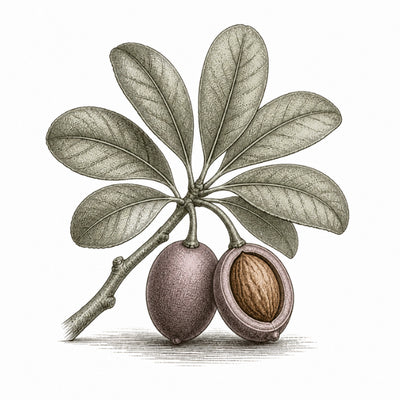
Butter
Shea butter
Butyrospermum parkii
A rich plant butter from the nuts of the shea tree, valued for centuries for protecting and softening skin.
Profile
- As listed on our products
- Butyrospermum Parkii (Shea) Butter
- Plant family
- Sapotaceae
- Part used
- Nut (kernel)
- Extraction
- Kernels crushed, roasted or dried, then pressed or kneaded to release the fat
- Origin
- The savanna belt of West and Central Africa
- Aroma and texture
- Rich and creamy, melting at body temperature; a soft, nutty scent
- Notable components
- Oleic acid (about 40–55%) and stearic acid (about 30–45%), with a high share of unsaponifiable matter (often 5–10% or more), including triterpene esters, phytosterols and tocopherols
- In our products
- Certified organic
About
The shea tree (Vitellaria paradoxa, long known as Butyrospermum parkii) grows across the savanna belt of West and Central Africa. It is almost never grown on plantations: most shea comes from wild or semi-wild trees left standing in farmers' fields. A tree usually takes ten to twenty years or more before it bears its first fruit, and may then keep fruiting for a century or longer.
The fruits fall in the rainy season. The nuts inside are gathered, boiled and dried, then the kernels are crushed, roasted and ground into a paste. Traditionally this paste is kneaded by hand with water until the fat separates and rises; today it may also be pressed.
What sets shea apart from most plant fats is its high share of unsaponifiable matter, the part of a fat that does not turn into soap. This fraction, rich in triterpene esters and sterols, is a large part of what makes shea so valued in skin care.
Properties and traditional use
Across West Africa, shea butter has been used for generations to protect skin and hair against dry Harmattan winds and strong sun, to care for babies' skin and in cooking.
In skin care it is valued as a rich emollient. It softens dry and rough skin, slows moisture loss from the surface and leaves a light protective layer. Its triterpene esters and sterols are often cited as the reason it feels so comforting on dry, tight skin.
Texture and skin feel
Shea butter is ivory to pale yellow, with a soft, slightly nutty, smoky scent that fades once it is blended. It is firm in the jar but starts to soften at around skin temperature, so it melts as you warm it between your fingers.
On the skin it feels rich and cushioning at first, then settles into a soft, supple finish. On its own it can feel heavy, which is why it works best balanced with lighter oils.
Why it is part of our work
Why we use it
Every balm needs a structure that holds the oils together and melts at the right moment. We use shea for that structure because it is a single, natural ingredient that does the job of a wax and a nourishing butter at the same time.
It also lets us make a balm without beeswax, so Itra can stay vegan.
In our formulations
Found in
-
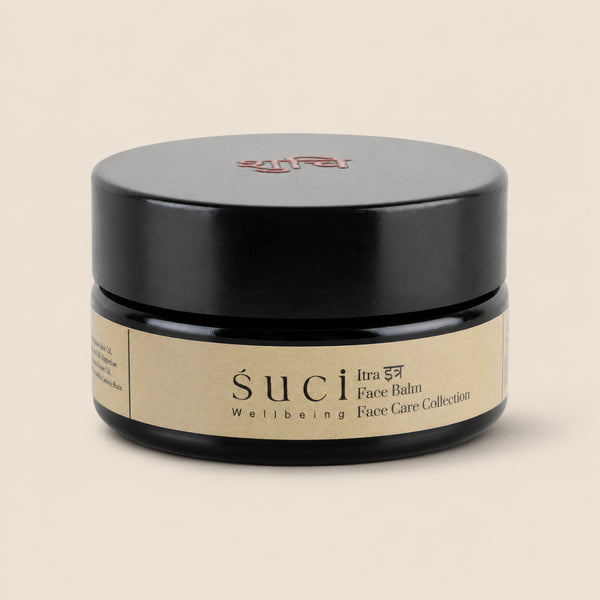
Face Balm
Itra
Discover ItraItra is built in three layers, and shea butter is the base of the first one, together with jojoba. It gives the balm its body: the rich texture you see in the jar and the protective quality that dry, tight skin asks for.
Shea on its own would feel heavy. Jojoba thins it out and sinks in quickly, so the balm melts as soon as you warm it between your fingertips and spreads without dragging.
It also carries the rest of the formula. The fatty-acid oils and the aromatic layer of blue tansy, rose, jasmine and sandalwood are held in the shea base and released slowly as it melts, which is why the scent of Itra stays soft rather than sharp.
Because shea is firm enough to give structure on its own, Itra needs no beeswax and is fully vegan.
Continue exploring

