
Essential oil
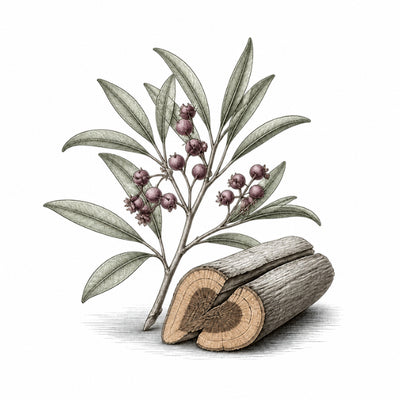
Australian sandalwood
Santalum spicatum
A soft, woody essential oil from Australian sandalwood, a sustainable relative of Indian sandalwood.
Profile
- As listed on our products
- Santalum Spicatum (Sandalwood) Wood Oil
- Plant family
- Santalaceae
- Part used
- Heartwood
- Extraction
- Steam distillation
- Origin
- South-western Australia
- Aroma and texture
- Soft, woody, creamy and dry
- Notable components
- Alpha- and beta-santalol, the alcohols behind sandalwood's creamy scent (in lower amounts than in Indian sandalwood), with farnesol and other sesquiterpene alcohols
- Note
- Base note
About
Santalum spicatum is a small, slow-growing tree of the dry woodlands of south-western Australia. Like all sandalwoods it is semi-parasitic: its roots attach to the roots of neighbouring plants to take up water and nutrients.
The aromatic oil builds up in the heartwood and roots over decades. The wood is chipped or powdered and steam distilled, a slow process because the oil is held deep in the dense wood.
Indian sandalwood (Santalum album) was harvested so heavily that it is now strictly protected and very scarce. Australian sandalwood is harvested under regulated programmes and gives a similar, slightly drier scent, which is why it has become a responsible alternative for perfumers and aromatherapists.
Properties and traditional use
Sandalwood has been central to ritual, perfumery and Ayurveda in India for thousands of years: as a paste on the forehead, in temple incense and carved into sacred objects. Aboriginal Australians traditionally used Santalum spicatum as well, including its nuts as food.
In aromatherapy, sandalwood is traditionally used for grounding and calm, for quiet moments and meditation. In skin care it is valued for dry skin and for its soft, comforting scent.
In skin care
For the skin
Australian sandalwood is valued for dry, dehydrated and mature skin. It has a softening, soothing character and is traditionally used to support skin that feels calm and comfortable and looks smoother.
Scent profile
Soft, woody and dry, with a creamy, slightly sweet undertone that becomes more noticeable as it warms. Compared with Indian sandalwood it is a little lighter and drier, with a fresh, almost green edge at first.
Sandalwood is a classic base note. It evaporates slowly and stays long after the lighter oils have gone, so it is the part of a blend you still notice hours later. It also acts as a fixative, allowing the more volatile notes around it to last longer.
Why it is part of our work
Why we use it
A base note decides how a blend ends, and we wanted that ending to be soft and calm. Sandalwood gives exactly that: a quiet, woody warmth that holds the lighter notes together without ever becoming heavy.
We chose Australian sandalwood (Santalum spicatum) for its scent and because it is harvested under regulated programmes, rather than the scarce and protected Indian sandalwood.
In our formulations
Found in
-
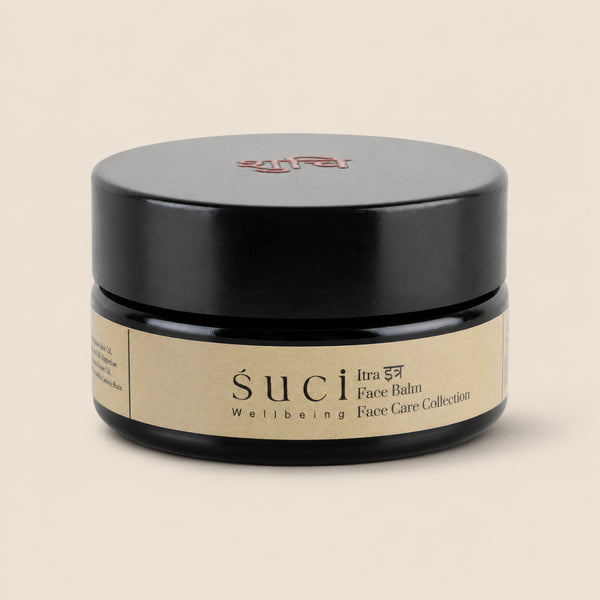
Face Balm
Itra
Discover ItraIn Itra, sandalwood is part of the aromatic layer, the third layer of the balm after the shea and jojoba base and the fatty-acid oils. It sits alongside rose, jasmine, frankincense, palmarosa, patchouli and blue tansy.
The florals give Itra its softness; sandalwood gives it warmth. It grounds the rose and jasmine so the scent reads as soft and warm rather than sweet, and it is one of the notes that stays on your skin once the balm has sunk in.
Its scent is also a natural match for a face balm: calm and familiar, never sharp, and pleasant to breathe in as you massage the balm into your skin.
-
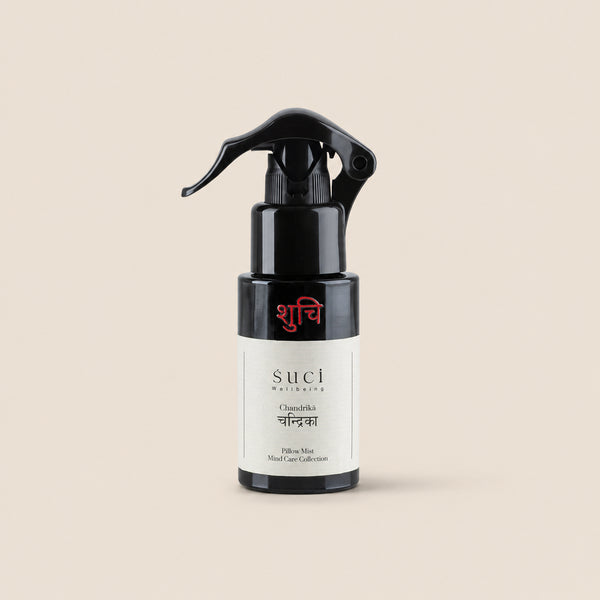
Pillow Mist
Chandrikā
Discover ChandrikāIn Chandrikā Pillow Mist, sandalwood is the base note. The blend moves from fresh grapefruit, through the floral heart of lavender, geranium and rose hydrosol, to sandalwood.
On fabric, the alcohol evaporates within moments and the lighter notes go first. Sandalwood is what stays on your pillow and linen longest, so it is the scent you notice as you lie down and settle.
We chose it as the ending of Chandrikā because its quiet, woody warmth fits the purpose of the mist: letting go of the day without anything that stimulates.
-
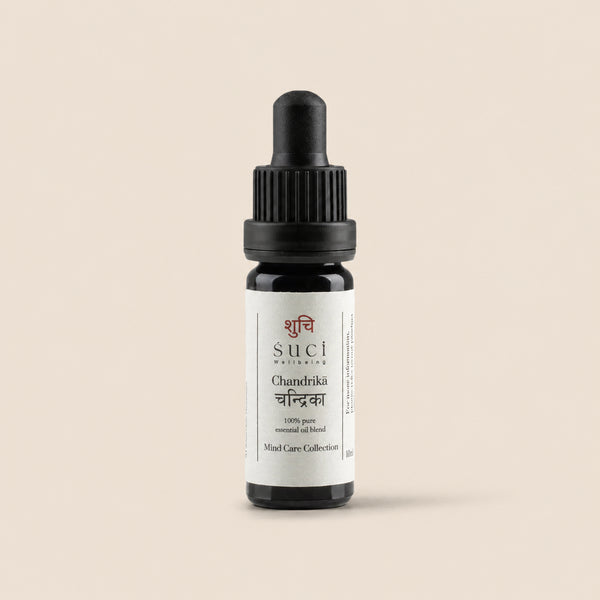
Essential Oil Blend
Chandrikā
Discover ChandrikāIn the Chandrikā essential oil blend, sandalwood is the base note under grapefruit, lavender and geranium. Of the four oils it evaporates slowest, so it carries the blend once the fresh grapefruit opening has faded.
It also acts as a fixative: it slows the evaporation of the lighter oils and gives the blend its staying power. In the diffuser, that means a scent that stays soft and present in the room, rather than flashing bright and disappearing.
Its calm, woody character grounds the fresh citrus and soft florals, turning them into a blend for unwinding in the evening.
Safe use
Diluting essential oils
General maximums for essential oils used on their own. Where the precautions below ask for less, or for no use on the skin at all, those always come first.
Continue exploring

