
Essential oil
Patchouli
Pogostemon cablin
A deep, earthy essential oil from patchouli leaves, which improves with age.
Profile
- As listed on our products
- Pogostemon Cablin (Patchouli) Leaf Oil
- Plant family
- Lamiaceae
- Part used
- Dried, lightly fermented leaves
- Extraction
- Steam distillation
- Origin
- Tropical South-East Asia; grown mainly in Indonesia
- Aroma and texture
- Earthy, deep, woody and sweet
- Notable components
- Patchoulol (patchouli alcohol), the main scent compound, with alpha-bulnesene, alpha-guaiene, seychellene and pogostol
- Note
- Base note
About
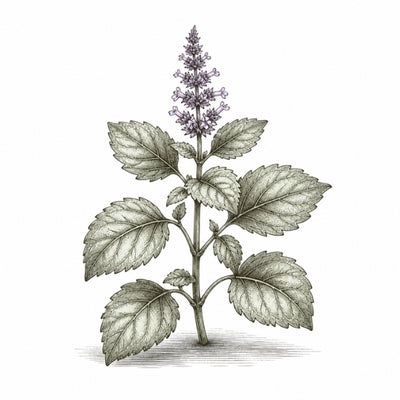
Patchouli is a bushy, tropical herb of the mint family, native to South-East Asia and grown mainly in Indonesia. Its large, soft leaves carry the oil in tiny glands.
After harvesting, the leaves are dried in the shade and often left to ferment lightly for some days. This breaks down the cell walls and develops the scent before steam distillation.
Unlike most essential oils, patchouli does not fade with age. Over the years it becomes richer, smoother and rounder, and well-aged patchouli is highly prized by perfumers.
Properties and traditional use
Patchouli became fashionable in Europe in the nineteenth century, when its scent was linked to fine shawls and textiles from India. In the 1960s and 1970s it took on a very different image, as the signature scent of a generation.
In aromatherapy, patchouli is traditionally used for grounding and calm. In skin care it is valued for dry and mature skin.
In skin care
For the skin
Patchouli is valued for dry, mature and rough skin. It is traditionally used to support skin that looks smoother and renewed, and has a calming character for skin that looks tired.
Scent profile
Deep, earthy and woody, with a damp, almost forest-floor quality and a soft, sweet, slightly chocolatey undertone. Freshly distilled patchouli can smell harsh and green; aged oil is smoother and warmer.
Patchouli is a base note and one of the longest-lasting essential oils. Used in small amounts it does not dominate: it gives florals depth and lets them last on the skin.
Why it is part of our work
Why we use it
Patchouli is powerful, so we use it with restraint. In small amounts it is one of the best oils for giving florals depth and staying power, turning a sweet floral note into something warmer and more grounded.
In our formulations
Found in
-
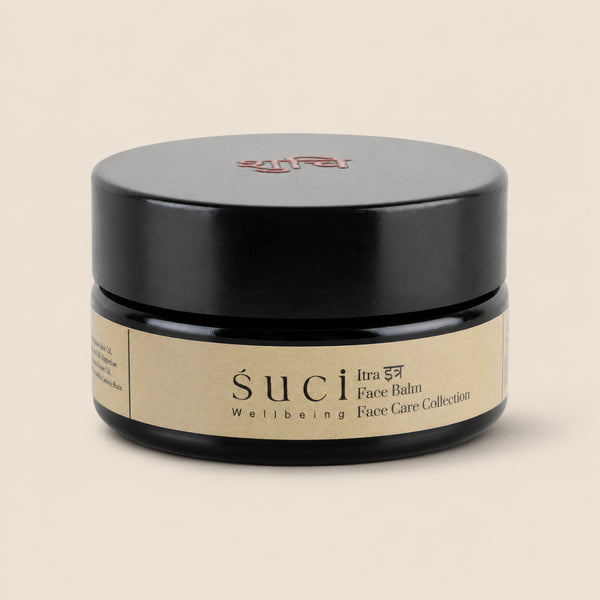
Face Balm
Itra
Discover ItraIn Itra, patchouli is part of the aromatic layer, alongside rose, jasmine, sandalwood, frankincense, palmarosa and blue tansy. It is used in a small amount: enough to anchor, not enough to be recognised on its own.
Its job is to ground the floral heart. Rose and jasmine are soft and sweet; patchouli gives them an earthy, woody depth, so Itra's scent reads as soft and warm rather than perfumed. As one of the slowest oils to evaporate, it also lets the scent stay with you after the balm has sunk in.
Safe use
Diluting essential oils
General maximums for essential oils used on their own. Where the precautions below ask for less, or for no use on the skin at all, those always come first.
Continue exploring

