
Mineral
Magnesium chloride
A natural mineral salt, the base of Nidrā Magnesium Mineral Bath.
Profile
- As listed on our products
- Magnesium Chloride
- Extraction
- Evaporated from brine
- Origin
- Mineral deposits and seawater
- Aroma and texture
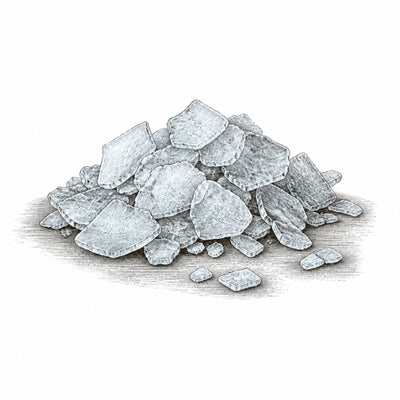
- Fine white flakes that dissolve in warm water; the water feels soft
- Notable components
- Magnesium chloride (MgCl2), usually in its hydrated form, magnesium chloride hexahydrate, made up of magnesium and chloride ions bound with water
About
Magnesium chloride occurs naturally in seawater and in brines from salt lakes and ancient underground seabeds.
It is obtained by evaporating brine. Magnesium chloride crystallises as white flakes or crystals that bind water from the air, which is why it is often called magnesium flakes or magnesium oil when dissolved.
It dissolves quickly and completely in warm water, which makes it well suited to a bath. Magnesium is an essential mineral that the body uses in many processes, including muscle function.
Properties and traditional use
Mineral baths have a long history in spa traditions across Europe, from Roman baths to the spa towns of the nineteenth century, many of them built around mineral springs.
Magnesium baths are traditionally used to relax tired muscles after physical effort. The water itself feels soft and slightly silky.
Texture and character
Magnesium chloride comes as white flakes without a scent of its own. In the bag, the flakes can stick together slightly, because they draw moisture from the air.
In warm water they dissolve within moments. The water does not foam or colour, but it feels softer and slightly silky on the skin.
Why it is part of our work
Why we use it
Magnesium chloride is the mineral base of Nidrā, in the tradition of mineral baths for tired muscles. It dissolves easily and completely, and it has no scent of its own, so it leaves room for the essential oils.
In our formulations
Found in
-
Magnesium Mineral Bath
Nidrā
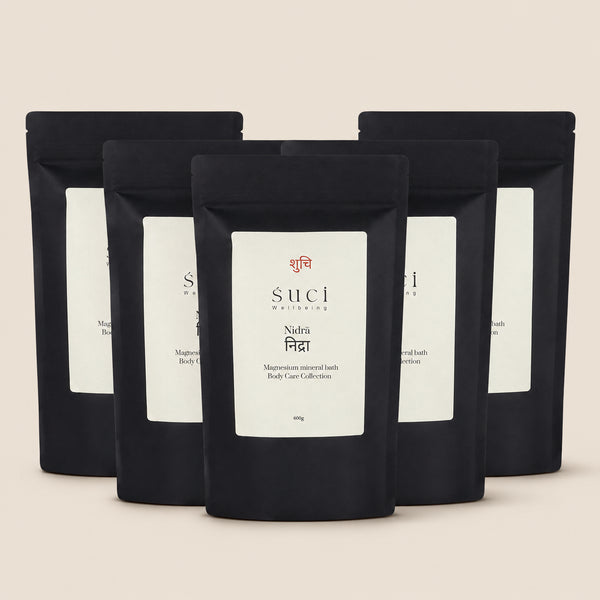
Discover NidrāMagnesium chloride forms the mineral base of Nidrā. Together with bolus alba, a fine white clay, it makes up the mineral part of the bath; the essential oils make up the aromatic part.
The magnesium is there to support muscle recovery, which is why Nidrā is meant for the moments your body asks you to slow down: after a workout, a physically demanding day or a busy week.
It dissolves completely in warm water at 37–39°C, without foam or colour. Together with the clay it gives the water a soft feel, while the warm water and steam release the scent of Spanish marjoram, lavender, frankincense and wintergreen. Twenty to thirty minutes in the bath gives the minerals and scent time to do their work.
Continue exploring

