
Essential oil
Lavender
Lavandula angustifolia
True lavender from the hills of southern France: fresh, floral and herbaceous, and the oil that shows best how the amount you use changes what an oil does.
Profile
- As listed on our products
- Lavandula Angustifolia (Lavender) Oil
- Plant family
- Lamiaceae
- Part used
- Flowering tops
- Extraction
- Steam distillation
- Origin
- The western Mediterranean; our single oil comes from France
- Aroma and texture
- Floral, herbal and soft
- Notable components
- Linalool and linalyl acetate, together usually more than half of the oil, with smaller amounts of terpinen-4-ol, lavandulyl acetate and ocimene, and very little camphor
- Note
- Heart note
- Our quality
- 100% pure essential oil, single origin (southern France)
About
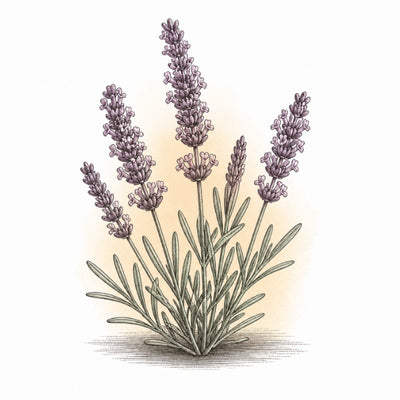
Lavandula angustifolia, known as true or fine lavender, is a small evergreen shrub of the mint family. It grows wild on the dry, stony slopes of the western Mediterranean, higher up than its relatives. The name is often linked to the Latin lavare, to wash: the Romans scented their bath water with it.
The oil sits in tiny glands on the flowers. The flowering tops are cut in summer, in full bloom, and steam distilled soon after harvest. It takes more than a hundred kilos of flowering tops to make one kilo of oil.
True lavender is often confused with lavandin (Lavandula x intermedia), a hybrid that gives far more oil and is widely used in detergents and inexpensive fragrance. Lavandin contains more camphor, which makes its scent sharper and more medicinal. Because 'lavender' on a label can mean either, we always name the species and where it comes from.
Properties and traditional use
Lavender has been part of European daily life for centuries: in bath water and laundry, in linen cupboards to keep moths away, and in the herbal traditions of monastery gardens.
It also has a place in the history of aromatherapy itself. The French chemist René-Maurice Gattefossé described treating a burn on his hand with lavender oil after a laboratory accident in the early twentieth century, an experience that led him to study essential oils and, later, to coin the word aromathérapie.
In aromatherapy, lavender is traditionally used for relaxation, nervous tension and restless sleep, and in skin care for sensitive and irritated skin. Its main components, linalool and linalyl acetate, have been studied for their calming effects, especially when inhaled. Results vary with the amount and the way it is used.
In skin care
For the skin
Lavender is valued for sensitive, irritated and blemish-prone skin. It is traditionally used to calm the look of redness, after sun or after shaving, and it suits almost every skin type.
Scent profile
The first impression is fresh, slightly green and herbaceous. Then comes the soft, floral sweetness most people recognise as lavender. As it dries down, a gentle, hay-like warmth remains, partly from natural traces of coumarin.
Lavender is a heart note. It bridges fresh top notes such as the citrus oils and deeper base notes such as woods and resins, which is why it appears in so many blends. Its character changes with the amount: a few drops read as soft and floral, a larger amount turns more herbal and sharp. You can smell the same two sides that make it calming in small amounts and activating in larger ones.
Why it is part of our work
Why we use it
Lavender is one of the few oils we offer on its own, because it is the oil we would recommend to anyone starting with aromatherapy: forgiving, well tolerated and useful in many ways.
It also shows something we apply to every formula: the amount matters. A little lavender calms; more becomes activating. We choose the amount of each oil for the effect we want, not only for the scent.
In our formulations
Found in
-
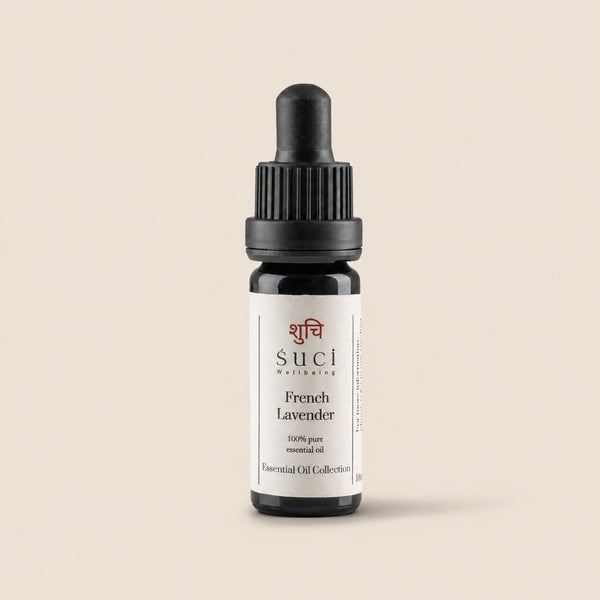
French Lavender - Lavandula angustifolia
Discover French Lavender - Lavandula angustifoliaThis is our lavender in its purest form: a single-origin oil from lavender grown in the hills of southern France, bottled in violet glass to protect it from light.
We chose Lavandula angustifolia rather than the cheaper lavandin, because its softer, sweeter and less camphoraceous scent is what lets lavender calm rather than sharpen. On the product page you will find the French Lavender Journey film and our full guide to using it.
-
Magnesium Mineral Bath
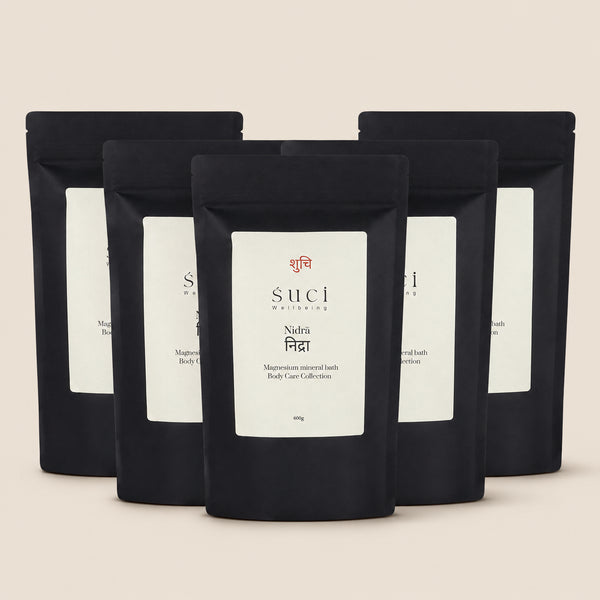
Nidrā
Discover NidrāIn Nidrā, lavender is the soft floral side of a fresh, herbal blend. The blend is built around Spanish marjoram (Thymus mastichina), which gives it an open, clean character, and lavender, which rounds it off and brings the relaxing note that suits a bath at the end of the day or after physical effort.
Frankincense (Boswellia carterii) adds a warm, resinous base, and wintergreen (Gaultheria procumbens) a cool sweetness. The warm water lets the aromatic molecules rise with the steam, so in the bath you mainly meet lavender by breathing it in while the minerals do their work.
-
Pillow Mist
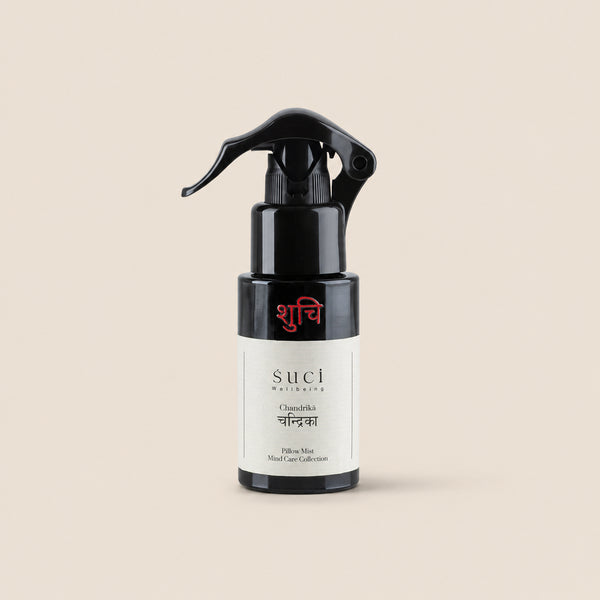
Chandrikā
Discover ChandrikāIn Chandrikā Pillow Mist, lavender forms the floral heart together with geranium and rose hydrosol, between the fresh grapefruit opening and the woody sandalwood base.
On its own, lavender is soft and herbal. In the mist, geranium and rose round it out, and sandalwood lets it linger, so what stays on your pillow and sheets is a calm, rounded scent rather than lavender alone.
-
Essential Oil Blend
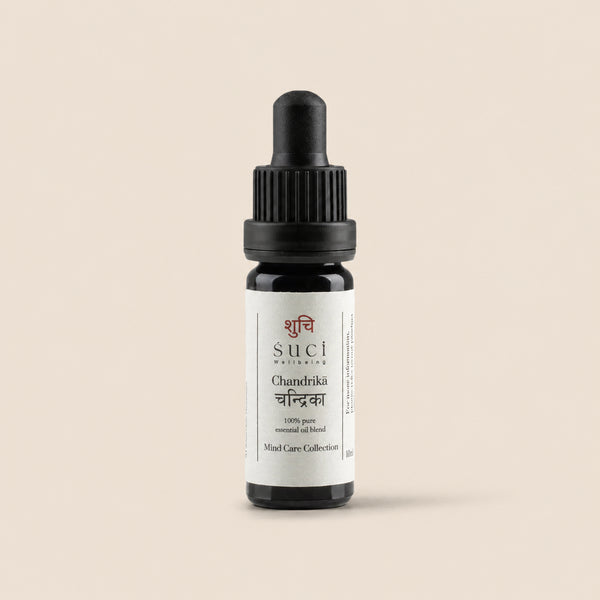
Chandrikā
Discover ChandrikāIn the Chandrikā essential oil blend, lavender sits at the heart together with geranium, between the fresh grapefruit opening and the woody sandalwood base.
On its own, lavender is soft and herbal. In Chandrikā it is part of something rounder: geranium adds a floral warmth, grapefruit keeps the opening light, and sandalwood holds everything in place, so the calm stays in the room long after the grapefruit has faded.
It is the four oils together that make Chandrikā a blend for letting go of the day.
Using it yourself
How to use
Calming or activating: the amount decides
A small amount calms and relaxes; a larger amount activates. For rest, use about 3–5 drops in a diffuser. For energy or a fresh start to the day, about 8–10 drops.
If you get a headache, you have used more than you need: air the room and use fewer drops next time.
In the diffuser
Fill the diffuser with water, preferably filtered, and add 3–10 drops depending on what you need and the size of the room. To wind down before sleep, diffuse 3–5 drops in the bedroom about 30 minutes before bed, or put a drop or two on your pillow.
On the skin
Dilute lavender in a carrier oil such as jojoba. For a body or massage oil, 2–10% is usual: 40–200 drops per 100 ml carrier oil. For the face, keep it lower, around 1%: about 2 drops per 10 ml.
Neat on a small spot
As a rare exception, lavender can be dabbed neat onto a very small area, such as an insect bite or a blemish. For anything larger, always dilute it.
In the bath
Essential oils do not dissolve in water, so mix lavender with a dispersible bath oil first. Adults: 10 drops at most in a full bath.
Safe use
Diluting essential oils
General maximums for essential oils used on their own. Where the precautions below ask for less, or for no use on the skin at all, those always come first.
Continue exploring

