
Carrier oil
Evening primrose
Oenothera biennis
A light oil from a flower that opens in the evening, known for its gamma-linolenic acid.
Profile
- As listed on our products
- Oenothera Biennis (Evening Primrose) Oil
- Plant family
- Onagraceae
- Part used
- Seed
- Extraction
- Cold pressed
- Origin
- North America; now naturalised in Europe
- Aroma and texture
- Light, soft, with a faint vegetal scent
- Notable components
- Linoleic acid (about 65–80%) and gamma-linolenic acid, GLA (about 8–11%), with smaller amounts of oleic and palmitic acid and natural tocopherols
- In our products
- Certified organic, cold pressed
About
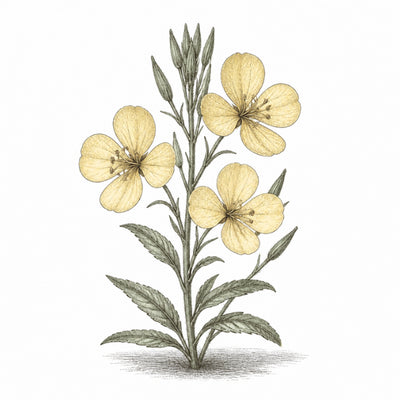
Evening primrose (Oenothera biennis) is a tall biennial plant from North America, now naturalised along roadsides and on dunes across Europe. In its first year it forms a low rosette of leaves; in its second it sends up a flowering stem with pale yellow flowers.
The flowers open at dusk and last only one night, attracting moths. They are followed by long seed pods, each holding hundreds of tiny seeds.
The seeds are cold pressed for an oil with an unusual profile. Besides a very high share of linoleic acid, it contains gamma-linolenic acid (GLA), a fatty acid found in only a handful of plant oils.
Properties and traditional use
Indigenous peoples of North America used the plant for food, and its leaves and roots in traditional preparations for the skin.
In skin care, linoleic acid and GLA are linked to the skin's barrier and its ability to hold on to moisture. Evening primrose oil is often chosen for dry, rough or sensitive skin and for skin that easily feels tight.
Texture and skin feel
Evening primrose oil is pale yellow, light and fluid, with a faint, vegetal scent. It spreads easily and absorbs at a moderate pace.
On its own it feels soft and slightly satiny. In a blend it is hardly noticeable as a texture; its contribution is in its fatty acids rather than its feel.
Why it is part of our work
Why we use it
We use evening primrose for one specific reason: its gamma-linolenic acid. It is one of the few plant oils that contain it, and it gives skin that is dry and in need of extra care something the more common oils cannot.
Because it is delicate, we always combine it with more stable oils rather than using it in large amounts.
In our formulations
Found in
-
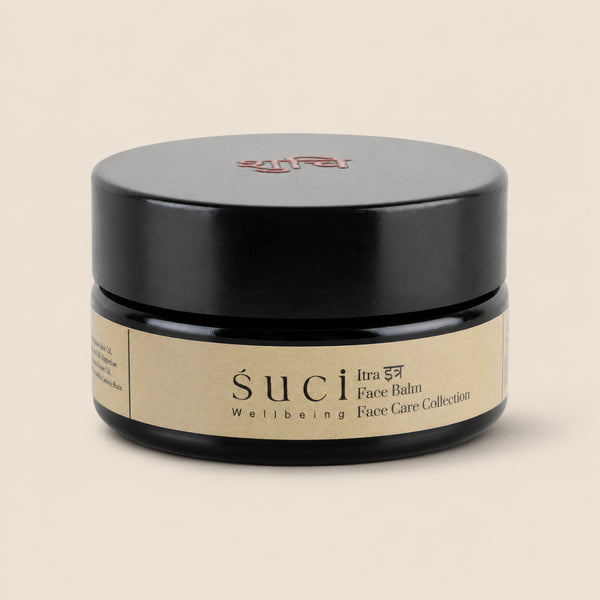
Face Balm
Itra
Discover ItraIn Itra, evening primrose belongs to the second layer of the balm, the fatty-acid oils, together with borage. Its job is to bring gamma-linolenic acid and a high share of linoleic acid into the formula, for skin that feels tight, dry or in need of extra care.
It works as a pair with borage. Borage is the richer source of GLA; evening primrose adds a gentler dose together with even more linoleic acid, so the two cover a broader range than either would alone.
Because both are delicate polyunsaturated oils, they are carried in the shea and jojoba base, which protects them. You will not notice evening primrose as a scent or texture: its role is in what the balm does for your skin over time.
Continue exploring

