
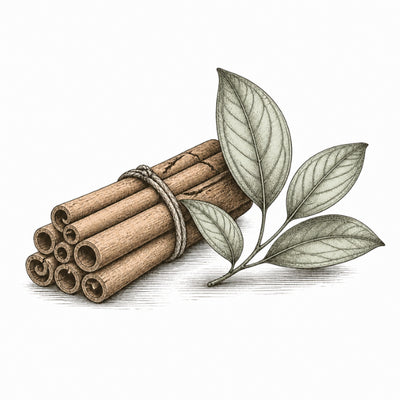
Essential oil
Cinnamon leaf
Cinnamomum verum
Distilled from the leaves of true cinnamon, the warm spice of Sri Lanka and the heart of Kṣiti.
Profile
- As listed on our products
- Cinnamomum zeylanicum (cinnamon) leaf oil
- Plant family
- Lauraceae
- Part used
- Leaf
- Extraction
- Steam distillation
- Origin
- Sri Lanka and southern India
- Aroma and texture
- Warm and spicy, with a clove-like edge
- Notable components
- Mainly eugenol, with smaller amounts of cinnamaldehyde, linalool and benzyl benzoate
- Note
- Heart note
About
Cinnamomum verum, also known as Cinnamomum zeylanicum, is true or Ceylon cinnamon: an evergreen tree of the laurel family, native to Sri Lanka and southern India. The young shoots are cut, and their thin inner bark is peeled and dried, curling into the quills we know as cinnamon sticks.
Essential oil can be distilled from the bark or from the leaves, and the two are very different. Bark oil is rich in cinnamaldehyde, which gives the sweet, hot spice of the stick. The oil we use is distilled from the leaves. It is mainly eugenol: warm and spicy, closer in scent to clove, and less sweet than bark oil.
True cinnamon is also different from cassia (Cinnamomum cassia), the coarser, more pungent spice often sold simply as cinnamon.
Properties and traditional use
Cinnamon was one of the most precious spices of the ancient world. It was traded across the ancient world to Egypt, Arabia and Rome, and its origin was kept deliberately vague by traders, surrounded by myths of fantastic birds and distant lands.
In aromatherapy, cinnamon is used to create a warm, comforting atmosphere, especially in the colder months.
In skin care
For the skin
Not for the skin. Cinnamon is a strong skin sensitiser, so we use it only in products for the home, for the warmth it brings to the air.
Scent profile
Warm and spicy, with the familiar character of cinnamon and a clove-like edge, less sweet than bark oil. It is powerful: a little fills a room.
Cinnamon leaf is a heart note. It is denser than citrus and carries a blend once the fresh top notes have faded, giving it body and warmth.
Why it is part of our work
Why we use it
Cinnamon brings a warmth no other oil quite matches. Because it is a strong skin sensitiser, we use it only in products for the home, never in products for the skin.
In our formulations
Found in
-
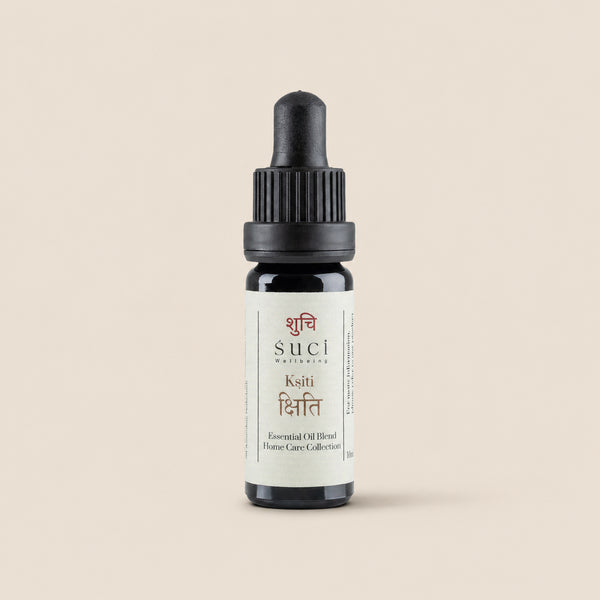
Essential Oil Blend
Kṣiti
Discover KṣitiIn the Kṣiti essential oil blend, cinnamon is the heart note between sweet orange and benzoin.
As the bright orange top note fades in the diffuser, cinnamon takes over and gives the blend its warmth and body. Benzoin then softens it with a sweet, balsamic depth. Each oil keeps the next in balance: the orange lightens the spice, the benzoin rounds it off.
It is cinnamon that gives Kṣiti its feeling of autumn indoors. Because it is so strong, the amount is kept in balance with the other two, so the scent stays warm without ever becoming too much.
-
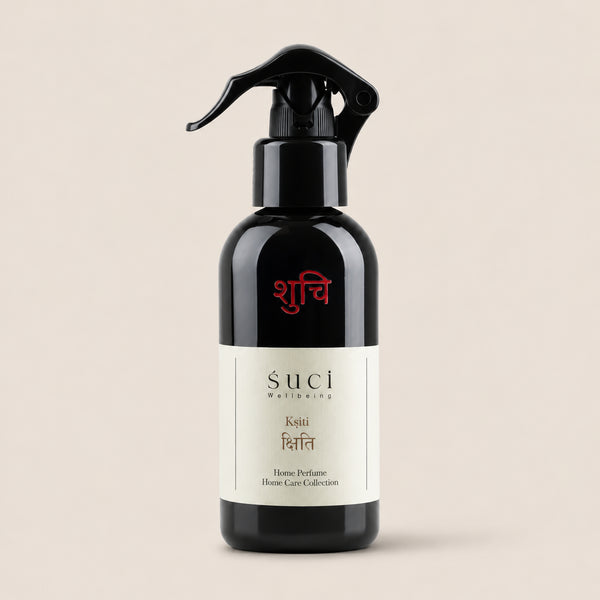
Home Perfume
Kṣiti
Discover KṣitiIn the Kṣiti home perfume, cinnamon is again the heart note, dissolved with sweet orange and benzoin in certified organic alcohol.
After the first burst of orange, cinnamon is the warmth that fills the room and lingers on soft textiles. Sprayed onto cushions or curtains, it is one of the warmer notes that stays noticeable longer, held in place by the benzoin.
As a home perfume for the air and textiles, not the skin, it is a good use for a spice we keep away from skin products.
Safe use
Diluting essential oils
General maximums for essential oils used on their own. Where the precautions below ask for less, or for no use on the skin at all, those always come first.
Continue exploring

