
Carrier oil
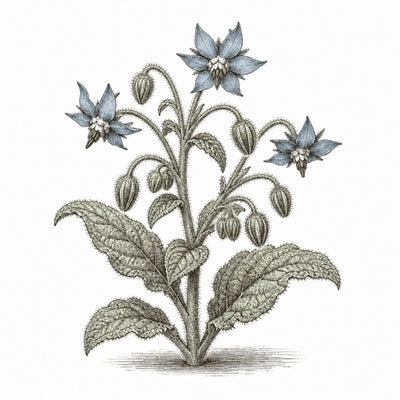
Borage
Borago officinalis
An oil from the seeds of the star-flowered borage plant, one of the richest plant sources of gamma-linolenic acid.
Profile
- As listed on our products
- Borago Officinalis (Borage) Seed Oil
- Plant family
- Boraginaceae
- Part used
- Seed
- Extraction
- Cold pressed
- Origin
- The Mediterranean region
- Aroma and texture
- Light, with a faint green scent
- Notable components
- Gamma-linolenic acid, GLA (about 18–25%), linoleic acid (about 35–40%), oleic acid (about 15–20%), with smaller amounts of palmitic and other fatty acids
- In our products
- Certified organic, cold pressed
About
Borage (Borago officinalis), also called starflower, is a hairy annual herb from the Mediterranean, now grown in gardens and fields across Europe. Its star-shaped flowers are a vivid blue and are much loved by bees.
After flowering, the plant forms small, dark seeds. These are cold pressed for an oil that is one of the richest plant sources of gamma-linolenic acid (GLA), with more than twice as much as evening primrose oil.
Like other oils high in polyunsaturated fatty acids, borage oil is delicate and oxidises easily. It is best used as part of a blend, alongside more stable oils.
Properties and traditional use
Borage has a long history in European herbal traditions. An old Latin saying, repeated by herbalists such as John Gerard in the sixteenth century, links it to courage, and its flowers and leaves were added to wine and cups.
In skin care, its GLA is valued for dry, rough and sensitive skin and for supporting the skin's barrier. It is often used in formulas for skin that feels tight or uncomfortable.
Texture and skin feel
Borage oil is pale yellow, light and fluid, with a faint green scent. It spreads easily and absorbs at a moderate pace, leaving a soft feel.
Like evening primrose, it is not chosen for its texture: in a blend it is barely noticeable, and its value lies in its fatty acids.
Why it is part of our work
Why we use it
Borage gives us the most concentrated source of gamma-linolenic acid we know of in a plant oil. A small share is enough to make a difference, which is why we use it in combination rather than on its own.
In our formulations
Found in
-
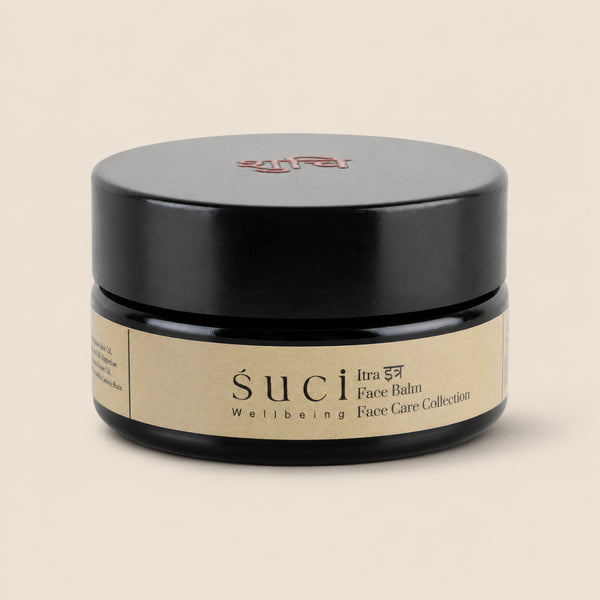
Face Balm
Itra
Discover ItraIn Itra, borage is part of the second layer of the balm, the fatty-acid oils, alongside evening primrose. It is the most concentrated source of gamma-linolenic acid in the formula.
It works hand in hand with evening primrose: borage brings the higher dose of GLA, evening primrose adds more linoleic acid, and together they give Itra its depth of care for dry, tight skin.
Borage is delicate, so it is held in the shea and jojoba base, which protects the oils and lets the balm melt into the skin. Its faint green scent disappears completely under the aromatic layer.
Continue exploring

