
Carrier oil
Baobab
Adansonia digitata
Pressed from the seeds of the African baobab, an oil with a balanced, smooth feel on the skin.
Profile
- As listed on our products
- Adansonia Digitata (Baobab) Seed Oil
- Plant family
- Malvaceae
- Part used
- Seed
- Extraction
- Cold pressed
- Origin
- Mainland Africa, especially the dry savanna
- Aroma and texture
- Medium-light, smooth, with a mild nutty scent
- Notable components
- Oleic acid (about 30–40%), linoleic acid (about 20–35%) and palmitic acid (about 20–30%), with natural tocopherols (vitamin E) and phytosterols
- In our products
- Certified organic, cold pressed
About
The baobab (Adansonia digitata) grows across the dry savannas of mainland Africa. It stores large amounts of water in its swollen trunk to survive long dry seasons, and individual trees are known to live for well over a thousand years. In many places it is called the tree of life.
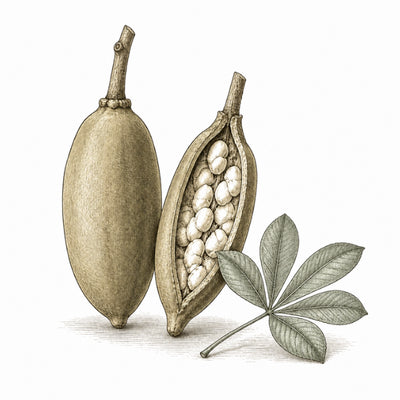
Its fruit is a large, velvety pod that dries on the branch. Inside, the seeds sit in a dry, chalky pulp. Across much of its range the fruit is still gathered from trees growing on community land, so the trade in pulp and oil brings income to rural areas.
The seeds are cleaned, dried and pressed without added heat. Cold pressing keeps the oil's natural tocopherols and sterols intact.
Properties and traditional use
In many African communities almost every part of the baobab is used: the leaves as a vegetable, the fruit pulp, rich in vitamin C, in drinks and porridge, the bark for fibre, and the seed oil to protect skin and hair against a dry climate.
In skin care, baobab is valued as an emollient for dry and mature skin. It softens, improves suppleness and reduces moisture loss from the surface of the skin. Because its fatty acids are well balanced, it suits most skin types without feeling heavy.
Texture and skin feel
Baobab oil is golden yellow, with a faint, nutty scent that disappears once it is part of a formula. Its texture is medium-light: richer than jojoba, lighter than shea. It spreads easily, absorbs at a moderate pace and leaves a smooth, satin finish rather than a shine.
In a cool room it can turn slightly cloudy or thicken, because of its palmitic acid. It clears again when warmed; this does not affect its quality.
Why it is part of our work
Why we use it
We look for oils that do more than one thing. Baobab gives a formula body and a pleasant feel on the skin, and its balanced fatty acids make it one of the more stable plant oils.
That stability matters to us. Our balms contain no water and no preservatives, so how long a product stays fresh depends on how well the oils themselves resist oxidation, the process that makes oils go rancid. Every oil we choose has to earn its place on that front as well.
Continue exploring

