


इत्र -Itra Face Balm
Tax included
Shipping calculated at checkout
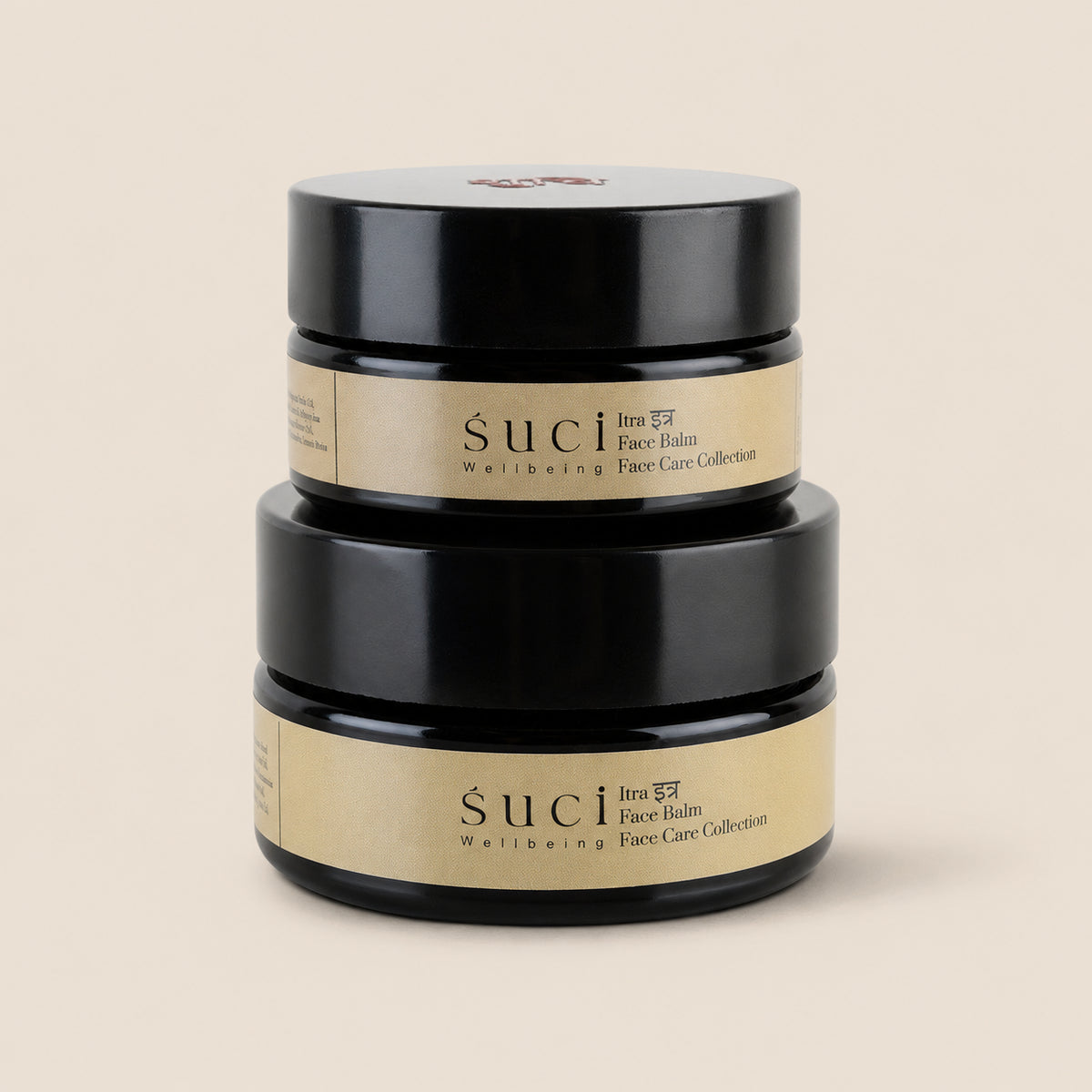
Itra, the Hindi word for perfume, which comes from the Arabic ʿiṭr, is a rich face balm for normal to dry skin, for the days your skin feels tight, dry or in need of extra care.
A base of plant butter and oils nourishes the skin and protects it from drying out. Rose (Rosa damascena), jasmine (Jasminum grandiflorum) and blue tansy (Tanacetum annuum) soothe and soften the skin, and give Itra its soft, warm scent.
It looks rich in the jar, but it melts as soon as you warm it between your fingertips and sinks into the skin without feeling heavy.
The result is skin that feels nourished, comfortable and smooth, with a soft, natural glow. Itra is vegan and beeswax-free, and made by hand in small batches.
Formulated by hand in small batches. With carefully sourced natural ingredients.
Water-free. A balm of plant oils, butters and essential oils, with no synthetic fragrance.
Goes well with

Face Care Gift Set - Itra Face Balm & Gulāba Face Mist
Face Care Gift Set - Itra Face Balm & Gulāba Face Mist
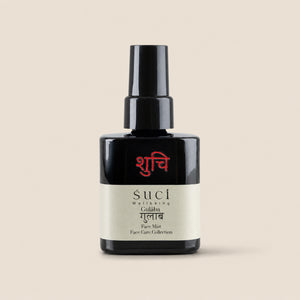
गुलाब - Gulāba Face Mist
गुलाब - Gulāba Face Mist
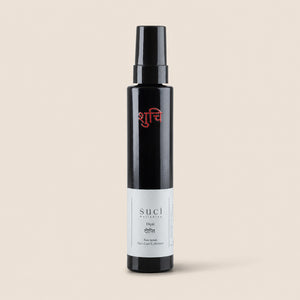
दीप्ति - Dīpti Face Serum
दीप्ति - Dīpti Face Serum
इत्र
Itra
Hindi for “perfume”
Face Balm
Key ingredients
- Rosehip (Rosa rubiginosa)fatty acids and naturally occurring vitamins
- Sea buckthorn CO₂ (Hippophae rhamnoides): carotenoids and antioxidants
- Blue tansy (Tanacetum annuum)chamazulene, which soothes and calms the skin
Key benefits
How it is built
The formulation
Application
How to use
Practical information
- Compact: 25 g, about one month when used twice a day
- Abundant: 50 g, about two months when used twice a day
- Vegan and beeswax-free
Full transparency
Ingredient list
Every ingredient is listed by its INCI name. INCI stands for International Nomenclature of Cosmetic Ingredients, the worldwide standard for naming ingredients on cosmetics. Each plant is named by its Latin botanical name and listed in order of quantity, so you know exactly what you are using. Natural does not mean without effect: please read the allergens and precautions before use.
Butyrospermum Parkii (Shea) Butter*, Simmondsia Chinensis (Jojoba) Seed Oil*, Rosa Rubiginosa (Rosehip) Seed Oil*, Oenothera Biennis (Evening Primrose) Oil*, Borago Officinalis (Borage) Seed Oil*, Hippophae Rhamnoides (Sea Buckthorn) Fruit Oil, Tanacetum Annuum (Blue Tansy) Flower Oil*, Rosa Damascena (Rose) Flower Oil, Jasminum Grandiflorum (Jasmine) Flower Oil, Santalum Spicatum (Sandalwood) Wood Oil, Boswellia Carterii (Frankincense) Resin Oil***, Cymbopogon Martini (Palmarosa) Oil, Pogostemon Cablin (Patchouli) Leaf Oil
* Certified organic
** Natural component of essential oil
*** Wild harvested
AllergensLinalool**, Bisabolol**, Chamazulene**, Citronellol**, Geraniol**, Eugenol**, Benzyl Benzoate**, Benzyl Alcohol**, Farnesol**, Limonene**
Questions
Frequently asked questions
About Śuci Wellbeing
What does Śuci mean?
Śuci is Sanskrit for pure, clear or bright. To us it means purity of mind, body and being: in the natural ingredients we choose, in our intentions and in the way we make decisions. It guides everything we make.
Why do your products have Sanskrit names?
Many Sanskrit words carry layers of meaning that English cannot hold in a single translation. Names such as Śuci, Prāṇa, Sūrya and Kṣiti carry philosophical, natural and cultural meanings that would largely disappear if we replaced them with purely functional English names.
Clarity matters just as much, so every name is paired with a plain English description, such as Sūrya Essential Oil Blend. The name keeps the meaning; the description tells you what the product is. Itra and Gulāba are Hindi words, with roots in Arabic and Persian.
Sanskrit is not decoration for us. It belongs to a long heritage of Hindu, Buddhist and Jain traditions, literature, philosophy and scholarship, and we use it with respect for where it comes from. Our understanding of wellbeing grew from practices rooted in India, yoga for Gioia and Buddhism for Jamal, and the name is our way of thanking that heritage. It is one of the influences behind Śuci Wellbeing, not an identity we claim. Read our story.
How are your products made?
We formulate and make our blends, mists, balms, serums and baths ourselves, and fill our essential oils by hand, always in small batches. Working this way lets us give close attention to every step and keeps sensitive natural materials fresh. We hand-pick the purest, highest-quality ingredients we can find.
Our incense is the one exception: it is hand-rolled for us in a village in South India, using a traditional blend of herbs, flowers and resins.
Who makes Śuci Wellbeing products?
So far, Gioia formulates every product herself and makes it by hand in Amsterdam. Our incense is collected by Gioia and Jamal themselves in South India.
What do the * markings in the ingredient lists mean?
* Certified organic
** Natural component of an essential oil
*** Wild harvested
Components such as linalool and geraniol occur naturally in essential oils. We list them because they are known allergens, not because they were added.
What goes into your products?
Natural ingredients only: plant oils and butters, essential oils, hydrosols, minerals and clay, each listed with its Latin name so you can see exactly what is used. We do not use synthetic fragrance. Our balm, serum, oil blends and bath are water-free, so there is nothing in them for microbes to grow in. Our incense is made with herbs, flowers and resins, without charcoal.
Did you know there are two ways of practising aromatherapy?
Aromatherapy is practised in two main ways, often called French and English aromatherapy. French aromatherapy grew out of medicine and pharmacy and is often combined with herbal medicine. There, essential oils may also be taken orally, under the guidance of a doctor, pharmacist or qualified practitioner. English aromatherapy works externally, through the skin and the breath: massage, baths and diffusion.
All Śuci Wellbeing products are made for external use.
Using our products
Are natural products always safe?
Natural does not automatically mean safe. Essential oils are highly concentrated plant extracts and act on the body. Always read the allergens and precautions, try a small amount first if you have sensitive skin, and speak to your doctor before use if you are pregnant, breastfeeding, have a medical condition or take medication. Keep all products out of reach of children.
Burn incense on a heat-proof holder, never leave it unattended, ventilate the room, and keep it away from children, pets and anything flammable.
Why do you use violet glass?
Violet glass filters out the light that speeds up oxidation, while letting violet and infrared light through. That way the oils keep their scent, colour and quality for longer.
How should I store my products?
Keep them closed, in a cool and dark place, away from direct sunlight and heat. Bath minerals should be kept dry, and incense is best kept sealed to preserve its scent.
Orders and shipping
Do you offer free shipping?
From €250. Within the Netherlands and the European Union, shipping is free on orders of €250 or more. Below that, shipping within the Netherlands costs €4.95 or €7.95 depending on your order, and within the European Union €15. To Norway and Switzerland, shipping costs €15.
Any more questions? We would love to hear from you.
Contact usOr email us at orders@suciwellbeing.com

